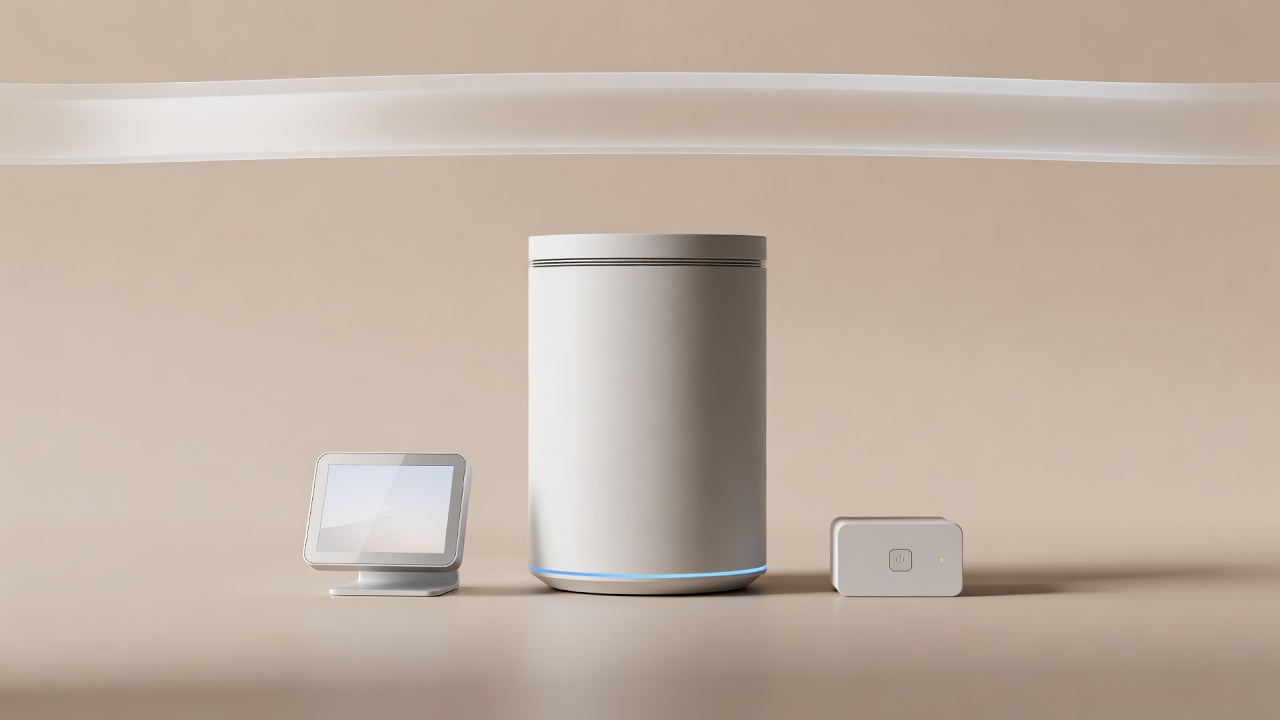
An air purifier is a fan pushing air through a filter. How much air it cleans, how well the filter traps particles and what replacement filters cost determine nearly everything. Smart devices, meanwhile, live or die by compatibility and how long the maker keeps them updated. This guide ranks both categories using criteria you can check on a spec sheet.
Size by CADR, not by "room size" claims
The Clean Air Delivery Rate, defined in the AHAM AC-1 test from the Association of Home Appliance Manufacturers, measures how quickly a purifier removes smoke, dust and pollen. AHAM's guideline is that smoke CADR in cubic feet per minute should be at least two-thirds of the room's floor area in square feet: a 300 sq ft room needs a CADR of about 200.
In metric terms, multiply room volume by the air changes per hour you want. A 20 m² bedroom with a 2.5 m ceiling holds 50 m³; for allergy relief aim for around five air changes, so look for at least 250 m³/h. Crucially, check the CADR at the fan speed you will tolerate at night, not at maximum.
Filters: real HEPA versus "HEPA-type"
Under the European standard EN 1822, an H13 filter captures at least 99.95% of particles at the most penetrating particle size; H14 reaches 99.995%. In the US, "true HEPA" typically means 99.97% at 0.3 microns. Terms like "HEPA-type" or "HEPA-style" are unregulated and usually signal a weaker filter.
HEPA does nothing for gases. For cooking smells, smoke odour or volatile organic compounds, you need activated carbon, and the weight of carbon matters more than its presence. A thin carbon-dusted sheet saturates quickly; granular beds of several hundred grams last much longer.
Avoid ozone
Ionisers, "plasma" modules and ozone generators can emit ozone, a lung irritant. The California Air Resources Board (CARB) certifies air cleaners that emit no more than 0.050 ppm of ozone; a CARB listing is a useful reassurance even outside California. If an ioniser can be switched off, do so.
How we rank air purifiers
| Criterion | Weight | What we check |
|---|---|---|
| CADR at quiet speed | 30% | Smoke CADR at a setting under ~40 dB |
| Annual running cost | 25% | Filter price × replacements + electricity |
| Filtration grade | 20% | Stated H13/true HEPA, sealed housing |
| Gas & odour handling | 10% | Carbon weight |
| Safety & usability | 15% | Ozone-free or CARB listed, filter indicator, sensor accuracy |
Smart home devices: start with compatibility
Matter, published by the Connectivity Standards Alliance in October 2022, lets a single device work with Apple Home, Google Home, Amazon Alexa and Samsung SmartThings. Many Matter devices use Thread, a low-power mesh network that does not clog your Wi-Fi and keeps working locally if the internet drops. Zigbee remains common and reliable but needs a compatible hub.
Prefer devices that offer local control, so lights and plugs still respond during a cloud outage. Read the privacy policy of anything with a camera or microphone.
Security and support periods
Since April 2024, the UK Product Security and Telecommunications Infrastructure regime bans universal default passwords on connected consumer products and requires manufacturers to state a minimum period of security updates. Treat that date like a best-before label: a cheap device with a short support window can become a liability.
Smart devices that pay their way
- Energy-monitoring smart plugs: reveal which appliances waste power, linking straight to our energy guide.
- Smart thermostats with room sensors: savings depend on your heating system and schedule discipline.
- Leak sensors: cheap insurance under washing machines and dishwashers.
Bottom line: for purifiers, buy CADR and cheap filters; for smart devices, buy Matter support and a long stated update period.
Should I run my purifier all the time?
Yes, on a low quiet speed. Continuous low-speed running usually cleans better than occasional bursts on maximum.
Are built-in air quality sensors accurate?
Most PM2.5 sensors track trends well but are not calibrated instruments. Use them for automation, not for medical decisions.