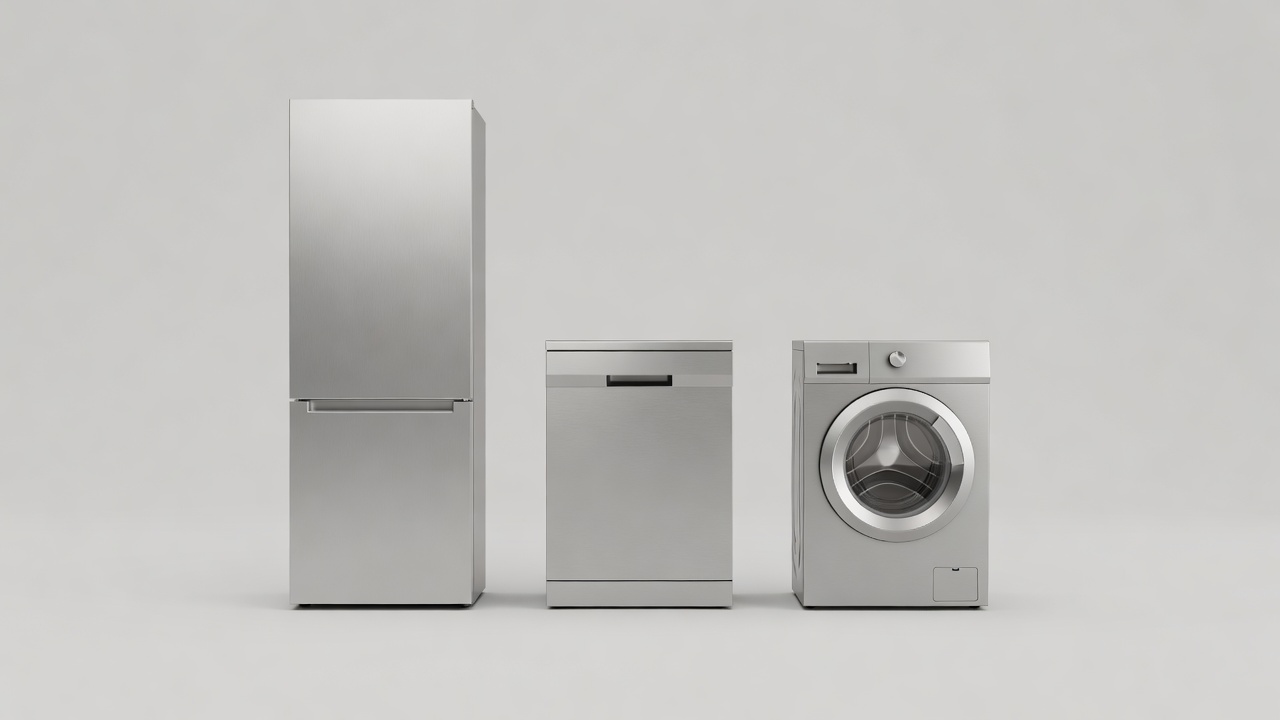
A fridge-freezer runs every hour of every day for ten years or more. A washing machine may complete well over two thousand cycles before it is retired. Over that kind of lifespan, a small difference in electricity use compounds into a sum that often exceeds the gap in purchase price. This guide explains how to read the efficiency labels used in Europe, the UK and North America, how to convert them into money, and when paying extra for a higher class genuinely pays back.
The rescaled EU and UK energy label
In March 2021 the European Union replaced the crowded A+++ to D scale with a simpler A to G scale for refrigerators, freezers, wine coolers, dishwashers, washing machines, washer-dryers and electronic displays. Light sources followed in September 2021, and Great Britain adopted the same rescaled format. The reset was deliberate: very few products launched in 2021 reached class A, which leaves room for future improvement without inventing more plus signs.
The consequence for shoppers is that a fridge rated A+++ under the old system frequently appears as class D or E today, without having become any less efficient. Never compare an old-format label in a second-hand listing with a new-format label in a shop.
Every new label also carries a QR code that links to EPREL, the European Product Registry for Energy Labelling. The registry holds the manufacturer's declared figures and the product information sheet for that exact model number, which is useful when a retailer's listing is vague or mixes up variants.
Which number actually matters
Classes are bands; kWh is the bill. Look for these figures:
- Fridges and freezers: annual consumption in kWh per year.
- Washing machines: kWh per 100 cycles on the standard "eco 40–60" programme, plus litres of water per cycle.
- Dishwashers: kWh per 100 cycles on the eco programme, plus water per cycle.
- Tumble dryers: annual kWh, still shown on the older label format while a revised label is prepared.
In the United States, ENERGY STAR, run by the Environmental Protection Agency since 1992, is a pass-or-fail certification for products that beat federal minimums. The yellow EnergyGuide label required by the Federal Trade Commission shows estimated yearly operating cost and kWh, which is the number to compare.
A simple lifetime cost formula
Lifetime cost = purchase price + (annual kWh × your tariff × expected years) + water and consumables.
Take two fridge-freezers: one using 112 kWh a year, another using 230 kWh. At 0.25 per kWh, the gap is about 29.50 per year. Over twelve years that adds up to roughly 354, frequently more than the price difference between the two. Run the same sum with your own tariff; when electricity is cheap, the payback period stretches.
| Appliance | Typical life | Number to compare | Efficient tech |
|---|---|---|---|
| Fridge-freezer | 10–15 years | kWh/year | Inverter compressor, good door seals |
| Washing machine | 10–12 years | kWh/100 cycles | Inverter motor, load sensing |
| Dishwasher | 9–12 years | kWh/100 cycles | Heat exchanger, zeolite drying |
| Tumble dryer | 8–12 years | kWh/year | Heat pump drying |
| Hob | 15+ years | Transfer efficiency | Induction |
Where efficiency premiums pay back fastest
The biggest wins come from appliances that run often and generate heat. Heat pump tumble dryers recycle warm air instead of venting it, typically using around half the electricity of a condenser model; for a family drying several loads a week, the premium can be recovered within a few years. Inverter-driven compressors in fridges and inverter motors in washers ramp up and down instead of cycling hard on and off, saving energy and reducing wear. Induction hobs transfer far more of their energy into the pan than gas, and heat up faster.
Small appliances are different. Efficiency gaps between kettles or toasters are minimal; boiling only the water you need saves more than any model upgrade.
Habits beat hardware
- Use eco programmes: they are long because they use less heat.
- Run full loads in washers and dishwashers, and wash at 30–40°C when possible.
- Set the fridge to about 4–5°C and the freezer to −18°C.
- Keep fridges away from ovens and direct sun, and vacuum the condenser coils yearly.
- Measure suspect appliances with an energy-monitoring smart plug before replacing them.
Our rule of thumb: if an appliance runs daily or holds a temperature all day, buy the most efficient model you can afford. If it runs a few minutes a week, buy for build quality and repairability instead.
Common questions
Is class A always worth the extra cost?
Not always. Calculate the kWh difference with your tariff. If payback exceeds the likely lifespan, a well-built class C or D model is better value.
Should I replace a working old fridge?
Measure it first for a week with a plug-in meter. Very old units can use several times more than new ones; a moderately old one may not justify the cost and waste of replacement.
Do smart features save energy?
Only if you use them, for example to shift washing to off-peak tariff hours.