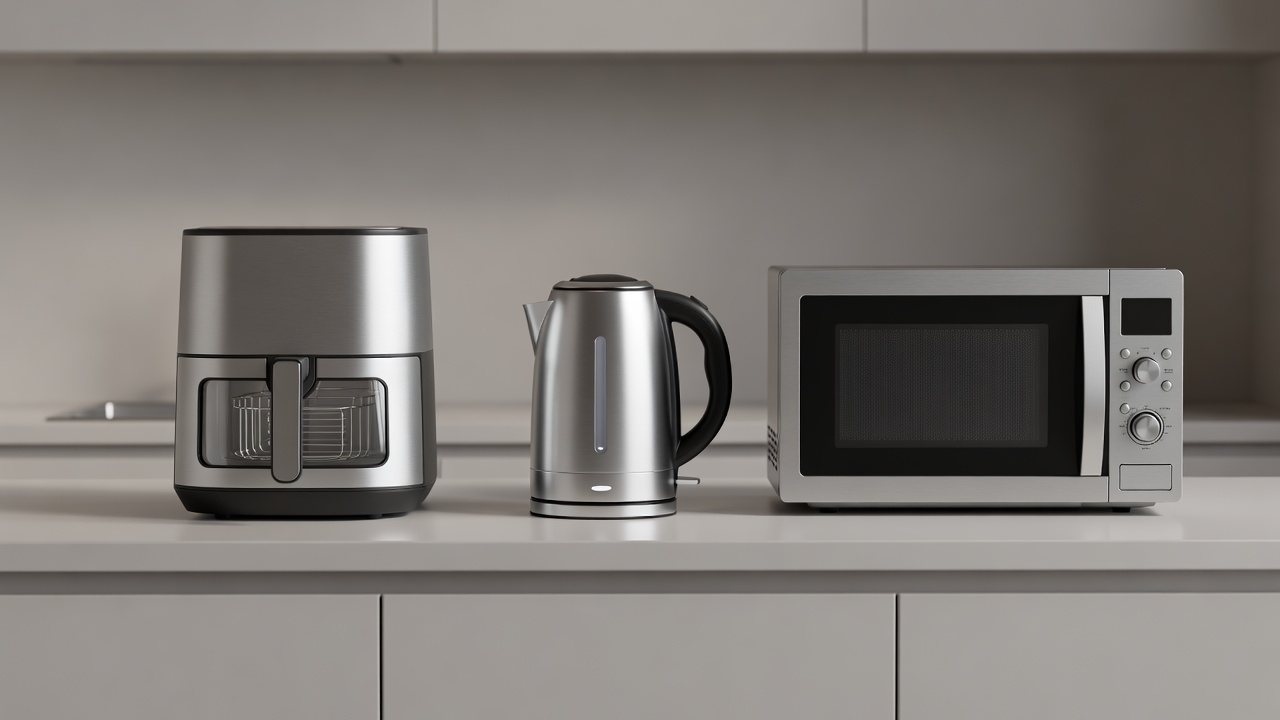
Kitchen equipment is where impulse buying peaks. A gadget used twice a year costs more per use than a premium appliance used daily. We rank kitchen gear by value: how often typical households use it, how much energy it saves against the alternative, and how long it is likely to last. Then we turn to maintenance, the cheapest way to make every appliance in the house last longer.
Kitchen equipment ranked by value
| Rank | Equipment | Why it earns its place |
|---|---|---|
| 1 | Induction hob | Fast, efficient, easy to clean; long service life |
| 2 | Combination microwave | Replaces a second oven for small meals |
| 3 | Air fryer | A compact convection oven that heats a small cavity quickly |
| 4 | Slow cooker | Low wattage over long periods, cheap cuts become tender |
| 5 | Stand mixer | Excellent for regular bakers; poor value otherwise |
| 6 | High-speed blender | Daily smoothie users only |
Before switching to induction, hold a fridge magnet to the base of your pans. If it sticks firmly, the pan will work. Aluminium and copper pans without a magnetic base will not, though adapter discs exist at a cost in efficiency.
Air fryers save energy mainly when cooking small portions that would otherwise heat a full-sized oven. For a family tray bake, the main oven is still the better choice.
Calculating value for money
Cost per use = (price + lifetime running costs) ÷ expected number of uses. A 400 stand mixer used weekly for ten years costs under 1 per use. A 60 spiraliser used three times costs 20 per use.
Repairability belongs in the same calculation. Since March 2021, EU ecodesign rules require manufacturers to make certain spare parts available to professional repairers for washing machines (ten years after the last unit is sold), dishwashers and refrigerators (seven to ten years, depending on the part). France introduced a repairability index score on products in 2021, which is a quick signal even for buyers elsewhere. A longer warranty, especially on motors and compressors, signals confidence in durability.
Household appliance maintenance schedule
| Task | Frequency | Why |
|---|---|---|
| Clean dishwasher filter | Weekly to monthly | Prevents gritty dishes and drain blockages |
| Empty maintenance wash at 60°C or hotter | Monthly | Stops odour and biofilm from low-temperature washing |
| Wipe washer door seal, leave door ajar | After use | Prevents mould on the rubber gasket |
| Descale kettle and coffee machine | 1–3 months in hard water | Limescale slows heating and wastes energy |
| Clean tumble dryer lint filter | Every load | Efficiency and fire safety |
| Wash vacuum filters, clear brush roll | Monthly | Restores suction |
| Vacuum air purifier pre-filter | Every 2–4 weeks | Extends main filter life |
| Clean extractor hood grease filters | 1–3 months | Airflow and fire risk |
| Vacuum fridge condenser coils | Every 6–12 months | Dust makes the compressor work harder |
Safety habits that protect your home
Register large appliances with the manufacturer so you are contacted about recalls; in the UK, the Register My Appliance portal run by the appliance manufacturers' association AMDEA covers many brands, and in the US the Consumer Product Safety Commission publishes recalls. Fire services advise against running tumble dryers and washing machines overnight or while out. Never cover ventilation grilles on fridges or microwaves.
Repair or replace?
A common rule is to repair if the cost is less than half the price of a comparable new appliance and the unit is less than halfway through its expected life. Older efficient machines can still be worth repairing; very old fridges and freezers are often worth replacing because of the energy saving.
Ten-minute habit: put the schedule above on your fridge. Most service call-outs we hear about involve a blocked filter or a neglected seal.
Can I use vinegar to descale everything?
Diluted vinegar or citric acid works for kettles, but check the manual for coffee machines; some seals and warranties require specific descalers.
Are extended warranties worth it?
Rarely for small appliances. For expensive items, compare the cost with typical repair prices and the manufacturer's own warranty first.